Optics hub
Compact reflective optics for EmberScope
The optical question is whether a compact reflective train can meet the mission without spending the detector, radiometry, and payload margins needed for a field camera.
Current readout · updated 1 August 2026
The P2 shortlist gate records a zero-of-three result.
Greg selected this exact fine-GSD custom-reflective research target after the 25 mm F/3.2 and 50 mm F/4 survey probes produced measured negative results. The bounded three- through seven-mirror runs now compare five architectures at identical target and acceptance gates; none passes. The hard-gated shortlist therefore contains zero designs, three short of the chartered deliverable. No optics have been fabricated, and the selected target is not the 500 ha/hour COTS-first survey baseline.
RFS-070 source-matched geometry
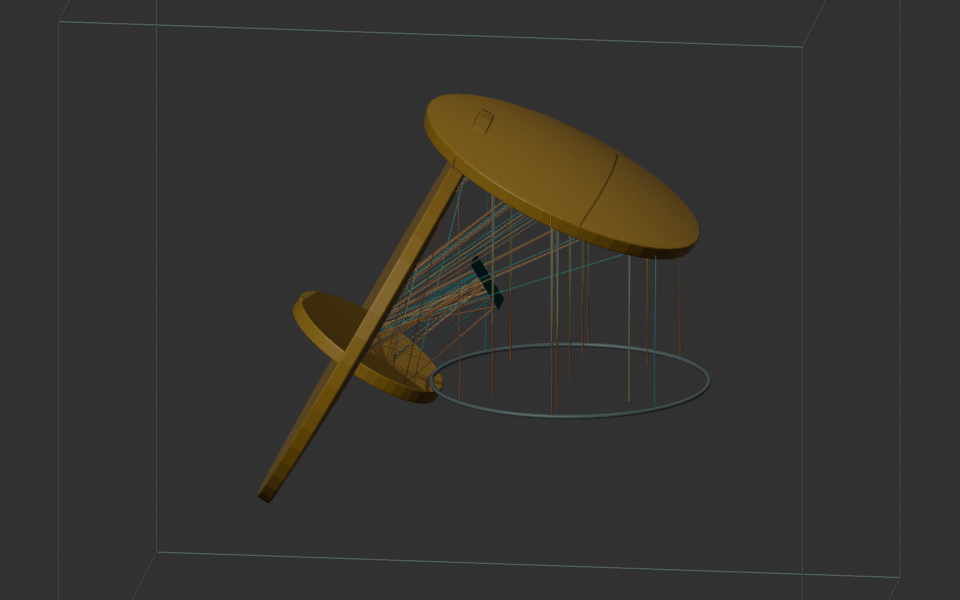
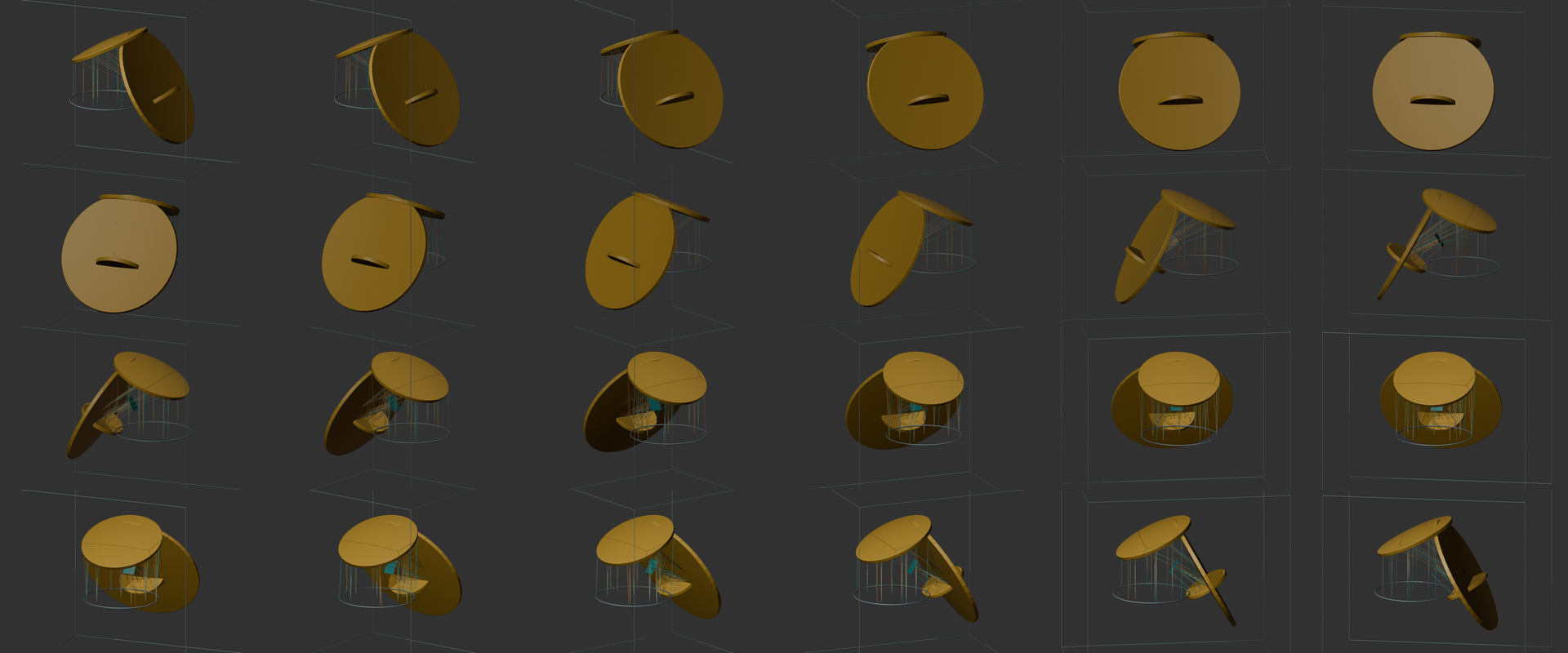
Rotate the latest measured three-mirror candidate — with its failed acceptance state attached.
The 24-view loop is rebuilt from the committed 1 August 2026 prescription, not from an illustrative redraw. Gold surfaces are the three recorded mirror meshes, the teal plate is the terminal flat detector plane, coloured lines are surviving display rays, and the wire cube is the 150 mm payload-envelope reference.
Ray-path design rules
Every optical comparison is scored against four practical ray-path rules.
The four checks: do not vignette the beam, keep fold angles small where practical, stop propagation at the image plane to set the detector position, and work toward a flatter image surface.
Every new candidate must prove all four at the approved target. A candidate cannot enter the shortlist unless every sampled field retains at least 90 percent unobscured throughput and reports detector-plane image quality at the shared flat image surface.
Optics evidence map
Start here, then open the detailed pages when a decision needs the numbers.
Optics restart targets
Open the conditional RFS-019 target register before restarting custom prescription work from the survey mission gates.
Optimized prescription
Download the optimized four-mirror prescription (surface table and field metrics, 10 June 2026) — the current reference design for tolerancing and fabrication review.
Optical baseline
Read the compact reflective baseline for the starting architecture, precedent papers, and design rules.
Optical evaluation
Open the evaluation stack for spot, detector-energy, vignetting, tolerance, and thermal-focus rows. Superseded for image quality by the optimized prescription; kept as the methodology record.
Multi-mirror candidates
Compare the screening branches — historical context for how the four-mirror branch was chosen. These seed layouts were later found self-obstructed and are superseded by the optimized prescription.
Optical literature
Read the literature synthesis for compact LWIR and freeform precedent families, including TMA examples.
Mechanical feasibility
Review package and tolerance feasibility before promoting any prescription.
Technical files
Download the technical files: the optimized prescription, the earlier packaging study's geometry exports, validation gates, CAD, and review package.
What remains to prove
The next optics pass must close image quality against the detector, not just package fit.
Mission targeting is fixed for the custom-reflective P2 comparison: 100 mm EFL at F/1.8. The bounded obstruction-aware four- through seven-mirror runs are now measured and all four are negative at the common gates; RFS-070 adds a three-mirror result that also fails. The seven-mirror cold-stop-relay row measures 6.0 mm EFL, 0 percent minimum reserved-trace throughput, and a 226.3 mm package span. The four-mirror row remains closest, but it also fails the hard gates. The RFS-065 shortlist gate now publishes the exact zero-of-three shortfall without promoting failed candidates. RFS-066 tolerance work and RFS-067 prescription exchange have no passing design to process; a new candidate family or revised optimization task requires explicit Greg/AAO direction.
That evidence should feed the radiometry story so GSD, NETD, and false-positive validation are calculated with measured optical terms rather than broad assumptions.