Optical evaluation stack - 30 May 2026
Each screened mirror candidate gets the same optical evaluation.
The proof-of-concept ray trace reports field, wavelength, detector-pixel energy, MTF proxy, vignetting, perturbation yield, thermal focus sensitivity, packaging, and small-hot-target impact in one repeatable table.
Checkpoint result
The stack is repeatable; the screened shapes were design baselines, not prototype prescriptions.
Evaluation stack
The checklist covers the optical terms that feed the detection model.
Each row records centroided spot size, ray-fan proxy, wavefront proxy, MTF proxy, pixel ensquared energy, vignetting, tolerance perturbation yield, thermal focus yield, manufacturability notes, package fit, and a small-hot-target SNR factor.
The wavefront and Zernike values are marked as ray-residual proxies. A true optical-path-difference model and a non-sequential stray-light model are still required before any candidate can be treated as fabrication-ready.
Candidate comparison
The edge-field detector-energy result is visible beside the geometry screen.
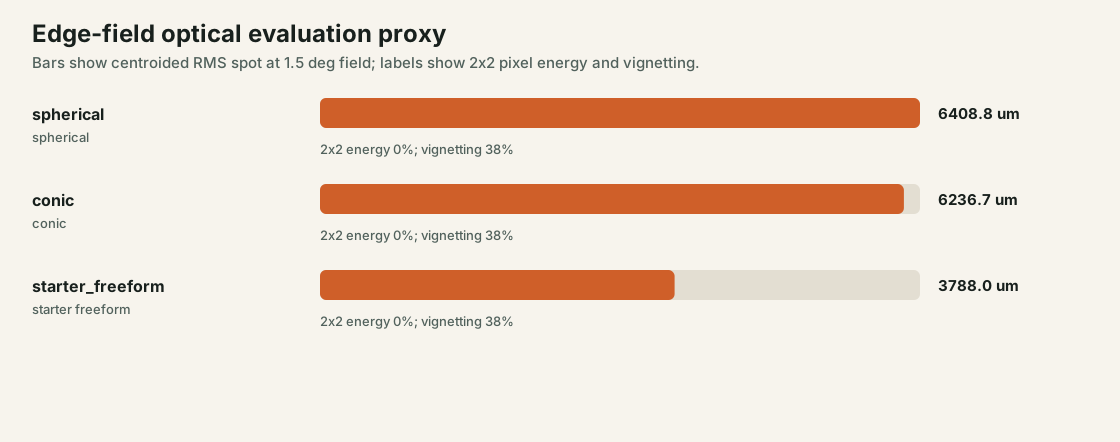
| Candidate | Family | Edge RMS | 2x2 pixel energy | MTF 0.5 Nyquist | SNR factor | Vignetting | Tolerance yield | Readiness |
|---|---|---|---|---|---|---|---|---|
| spherical | spherical | 6408.8 um | 0% | 0% | 0% | 38% | 0% | Needs maturation: image energy is too spread for the detector proxy. |
| conic | conic | 6236.7 um | 0% | 0% | 0% | 38% | 0% | Needs maturation: image energy is too spread for the detector proxy. |
| starter_freeform | starter freeform | 3788.0 um | 0% | 0% | 0% | 38% | 0% | Needs maturation: image energy is too spread for the detector proxy. |
The SNR factor combines the current optical transmission proxy, vignetting, and two-pixel ensquared energy. It should replace the assumed image-energy term in the end-to-end model only after the candidate prescription is improved.
Open limits
The new table exposes the next optical work instead of hiding it.
True WFE still needs OPD tracing
The report carries WFE and Zernike-labelled proxy columns, but diffraction claims need optical-path-difference sampling.
Ghosts need a non-sequential model
Window reflections, warm housing paths, baffle scatter, and detector narcissus are outside the current sequential trace.
Candidate prescriptions need optimization
The current shapes are useful baselines; the detector-energy rows show why they are not yet prototype prescriptions.
Detection rows can use measured optics
The 2x2-pixel energy and MTF fields give the end-to-end model a concrete replacement for assumed image-spread factors.