End-to-end simulation - 29 May 2026
The first full-row detection checkpoint is repeatable.
EmberScope links target radiance, detector noise, optical throughput, image spread, survey geometry, and false-positive floors in one deterministic scenario table.
Current result
Hot centimetre-scale targets clear the first gate; weak warm edges do not at the 120 m clutter-stress setting.
Model boundary
This is a first-gate simulation, not a field-validated detection-probability claim.
The calculation reuses the Planck, fill-factor, low-altitude transmission, and NETD radiometry model plus the current survey operations model. It then applies a three-mirror LWIR throughput proxy, image-energy fractions, calibration residuals, and explicit false-positive apparent-temperature floors.
The detection threshold is the larger of a six-sigma detector and calibration gate or the selected false-positive floor. The margin is the throughput- and image-spread-adjusted apparent temperature contrast divided by that threshold.
Scenario results
The weak row is visible instead of hidden behind the easy flame cases.
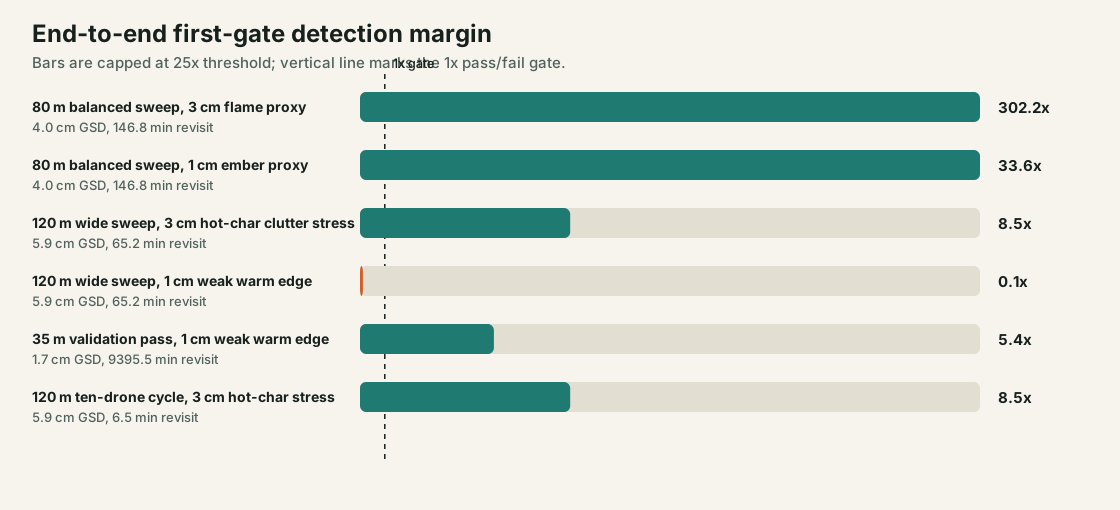
| Scenario | Target | GSD | Revisit | Adjusted delta | Threshold | Margin | Disposition |
|---|---|---|---|---|---|---|---|
| 80 m balanced sweep, flame proxy | 3.0 cm, 700 K | 4.0 cm | 146.8 min | 209.89 K | 0.69 K | 302.2x | Strong first-gate margin |
| 80 m balanced sweep, ember proxy | 1.0 cm, 700 K | 4.0 cm | 146.8 min | 23.32 K | 0.69 K | 33.6x | Strong first-gate margin |
| 120 m wide sweep, hot-char clutter stress | 3.0 cm, 430 K | 5.9 cm | 65.2 min | 16.95 K | 2.00 K | 8.5x | Passes first gate |
| 120 m wide sweep, weak warm edge | 1.0 cm, 330 K | 5.9 cm | 65.2 min | 0.23 K | 2.00 K | 0.1x | Below first gate |
| 35 m validation pass, weak warm edge | 1.0 cm, 330 K | 1.7 cm | 9395.5 min | 3.75 K | 0.69 K | 5.4x | Passes first gate |
| 120 m ten-drone cycle, hot-char stress | 3.0 cm, 430 K | 5.9 cm | 6.5 min | 16.95 K | 2.00 K | 8.5x | Passes first gate |
Adjusted delta includes optical throughput and image-energy fractions. The review-pressure proxy and raw output table are in the generated end-to-end CSV artifact.
Engineering readout
The next optical and field tasks have a shared scoring row.
Hot targets are not the limiting case
The hot 3 cm and 1 cm rows retain large first-gate margin after throughput and image-spread allowances.
120 m weak edges fail the current stress test
The 1 cm, 330 K weak warm-edge row falls below the sun-warmed clutter floor at the current wide-sweep altitude.
Validation flights are a different mode
The 35 m pass rescues the weak target, but its route spacing is too tight for broad-area search.
Fleet size changes revisit only
The ten-drone row improves rediscovery timing without improving single-pass contrast, optics, or calibration.
Next closure
The provisional values name the measurements needed next.
The false-positive floors need Rural Fire Service stakeholder review and no-fire flight data. The image-energy fractions need to be replaced by real PSF/MTF/ensquared-energy output from the chosen optical prescription.
Published artifacts are the
scenario CSV,
scenario JSON,
and the local technical report at
projects/rural-fire-service-camera/end-to-end-simulation-report-2026-05-29.md.