Validation plan - 16 May 2026
Dataset validation plan
This is the public plan for eventually proving fire detection without hiding behind random frame splits, visible-flame shortcuts, or unmeasured false positives. The first public radiometric replay now exists, and it rejects the current detector profile on no-fire clutter. The 31 July scope correction retains that result as camera-software evidence, not optical-design evidence.
Evidence base
The plan is grounded in the public FLAME sequence and the current EmberScope mission requirements.
Implementation checkpoint - 29 July 2026
The FLAME 3 ingestion adapter now rejects incomplete or ambiguous radiometric inputs before scoring.
rfs_flame3_ingest.py scans a caller-supplied dataset directory
outside git and implements the published same-stem four-file pairing for raw
RGB, corrected-FOV RGB, thermal JPEG, and Celsius TIFF imagery.
Pairing integrity
Every label folder must contain the same filename stems in all four modalities; missing or duplicate stems stop ingestion.
Radiometric gate
Each TIFF is checked as a finite, single-band float32 Celsius raster at the metadata-declared dimensions, with the Celsius-to-Kelvin conversion recorded explicitly.
Provenance
Every source file is SHA-256 checked, and preserved thermal-JPEG EXIF supplies the acquisition day and observed camera model.
Replay contract
The adapter emits a detailed provenance manifest and an RFS-047 dataset-export manifest with group-disjoint burn, site, day, and sensor splits.
The first public FLAME 3 replay is now recorded below. It uses the corrected
Thermal/Raw JPG source path and all 738 public Sycan Marsh
quartets. It remains a single-burn detector-software diagnostic; the
31 July scope correction closes active RFS-069 work without claiming
burn-held-out acceptance.
Source convention: FLAME 3 dataset DOI and the published processing pipeline.
Measured replay - 30 July 2026
The current detector finds the fire-labelled frames but fails the public no-fire stress case.
The unchanged compact-hot-v1 profile was replayed across every
radiometric TIFF in the public FLAME 3 Computer Vision Subset (Sycan Marsh),
DOI 10.21227/w0mz-aq48. This is real public imagery rather than
synthetic injection.
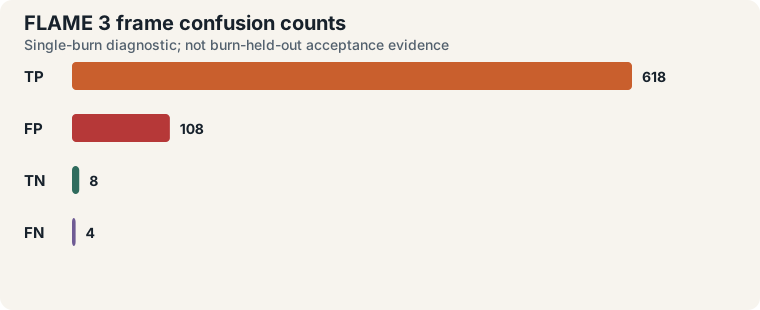
All four reconstructed no-fire sequences produced alerts. The high recall is therefore not an operational success: broad fire-scene labels and class imbalance conceal a clutter-rejection failure that would overload review. The four missed fire frames are one-frame sequences and cannot satisfy the configured two-frame persistence gate.
The reproducible result manifest records the exact archive, code and manifest checksums; unchanged thresholds; declared split and sequence rule; frame and sequence metrics; every failed frame ID; and the source limitations.
This is a single-burn diagnostic, not burn-held-out acceptance evidence. The public source contains one Sycan Marsh burn; the paper says the full six-burn source is available on request. Preserved thermal-JPEG EXIF also reports 25-27 October 2022 while the public data card describes 25-27 October 2023; the replay preserves the observed EXIF and records the discrepancy.
Sources: dataset DOI and public Sycan Marsh subset.
Scope correction - 31 July 2026
FLAME 3 is retained as a detector-software side result, not evidence for candidate optics.
The replay reads native DJI M30T Celsius pixels, converts them to Kelvin,
and passes them directly to compact-hot-v1. It does not apply
an EmberScope optical prescription.
What the replay measures
Transfer of the current threshold detector to public DJI thermal scenes, including its measured no-fire clutter-rejection failure.
What it does not measure
Candidate focal length, F-number, throughput, PSF/MTF, image spread, vignetting, plate scale, GSD, detector sampling, NETD, or noise.
Current decision
No further FLAME 3 acquisition is required. RFS-069 closes without a burn-held-out acceptance claim, and the active project returns to optical candidates and prescriptions.
Possible future use
A separately authorized end-to-end simulation could transform scene radiometry through each candidate's measured optics and detector response before detection.
The 24 July approval selected the 100 mm F/1.8 custom-optics target and continued engineering work. The agent proposed the later FLAME 3 tasks while expanding that queue; they were not a separate detector-development request from Greg. Greg explicitly approved this scope and provenance correction on 31 July.
Validation principle
EmberScope should be tested as a radiometric survey payload, not as a generic fire-picture classifier.
A useful benchmark has to show detection of weak or small hot targets at the drone GSD and dwell time, rejection of rural no-fire clutter, and survival of held-out burns, sites, days, and sensor paths.
The plan keeps RGB-only, thermal-only, RGB/thermal, and RGB/radiometric-TIFF scores separate so visible smoke or flame cues cannot disguise weak thermal performance.
Validation stack
The headline split must hold out burns and backgrounds, not just shuffled frames.
| Validation layer | What it tests | Required output |
|---|---|---|
| Burn-held-out public data | Generalization across complete fire events rather than adjacent video frames. | Precision, recall, specificity, sensitivity, F1, ROC/PR data, and confusion matrix by modality. |
| No-fire stress set | False alarms from sun-heated clutter, vehicles, people, structures, smoke, shadows, water, and residual heat. | False positives per flight minute and per surveyed hectare, with representative rejected examples. |
| Radiometric TIFF / raw thermal path | Whether the detector chain works from temperature-like data rather than palette color alone. | Thermal-only, RGB/thermal, and RGB/radiometric-TIFF results reported separately. |
| Small-hot-target simulation | EmberScope's centimetre-scale target after GSD, dwell, blur, noise, and calibration error are known. | Detection curves versus target size, target radiance or temperature, background, altitude, and threshold. |
| Local EmberScope field data | Same detector, calibration kit, optics, geotagging, and survey profile as the payload under test. | Field surrogate results and failed-case packet ready for engineering review. |
False-positive policy
The negative set has to look like rural fire-service operating terrain, not a clean lab background.
Hot clutter
Sun-heated rocks, bare ground, roads, rooftops, metal gates, vehicles, and machinery.
Warm non-fire objects
People, livestock, buildings, camp equipment, and other warm objects that operators must not chase as fire.
Atmospheric and optical confusion
Smoke, dust, haze, shadows, clouds, water, reflective surfaces, and RGB/thermal alignment offsets.
Operational negatives
Pre-burn, post-burn, and same-terrain no-fire flights at comparable altitude, speed, time of day, and solar loading.
Acceptance gate
No detection claim should ship without provenance, held-out data, and failed examples.
A credible first report needs a burn-held-out public score, a no-fire stress score, a radiometric-TIFF or raw-radiometry score, an EmberScope-specific small-hot-target simulation, and a packet of missed detections and false positives for review.
These are detector-validation gates, not optical-design gates. They apply only if a future detector-validation effort is separately authorized.
Every run should record dataset source, version, checksum, split definition, model or rule version, threshold, detector assumptions, calibration inputs, GSD, altitude, frame rate, and reviewer label provenance. Raw datasets and bulky experiment outputs should stay outside routine public materials unless intentionally packaged for review.